
Nat Rubio-Licht
Nat Rubio-Licht is a Senior Reporter at The Deep View. Nat previously led CIO Upside, a newsletter dedicated to enterprise tech, for The Daily Upside. They've also worked for Protocol, The LA Business Journal, and Seattle Magazine. Reach out to Nat at [email protected].
Articles

Newsom pitches California AI rules as US template
As it stands, regulation in the US has not been able to keep pace with the rapid development of frontier AI. Several new efforts out of California seek to change that.
On Wednesday, Calif. Gov. Gavin Newsom unveiled a proposal that would give the state a stronger ability to regulate AI safety. Newsom's proposal would give the state emergency shutdown authority over AI, baseline safety standards for developers, impose mandatory third-party oversight and cap recursive self-improvement.
"California isn’t waiting until it is too late. We are updating and strengthening our nation-leading framework to move as quickly as technology evolves," Newsom said in a statement. "We’re showing the country what responsible leadership looks like."
California has largely led the way on state AI regulation, imposing laws seeking to make AI more transparent, establish independent oversight, and require safeguards for child safety around chatbots. However, the regulatory landscape is mixed across the country, creating a patchwork of regulation for something that has a global impact.
Newsom told reporters on Wednesday that he aims for this to be a framework that can be applied nationally.
"This takes things to the next level, not only of conversation, but of consciousness in terms of how we effectively regulate artificial intelligence, not only in my home state, but we believe a template for how we should be doing it federally as well," Newsom said.
However, while new regulation is creeping in slowly, a new lawsuit could test the mettle of existing laws against the fast-moving tech: On Monday, California Attorney General Rob Bonta filed a lawsuit against OpenAI alleging that the AI lab prioritized rapid AI development over public safety. The lawsuit centers around the company's breach of HuggingFace in July, arguing that OpenAI was negligent in not adequately securing its testing environments.
The claim throws a number of allegations at OpenAI, including that it ignored opportunities to prevent the attack, misled consumers about the tech's safety, and withheld information from regulators.
Legally, the complaint is based on two primary causes of action: Violating the Unfair Competition Law, which claims that the company engaged in deceptive business practices, and a public nuisance claim, which can hold companies liable for infringing on common rights shared by the public—in this case, the right to a safe and secure internet.
"The company knowingly tested a dangerous product without proper oversight or safety procedures and misled the public about it—this disregard for public safety violated California law," Bonta's office said in a statement. "Without sufficient safeguards and controls, the scope and frequency of this already unacceptable risk will only increase."
OpenAI has since pushed back, with spokesperson Drew Pusateri telling BBC on Monday that the lawsuit "appears to single out OpenAI over a challenge that's been identified by every major AI lab."
This lawsuit could represent a major test for the efficacy of policing AI through the existing legal system, Tess Vartanian, legal fellow for the Center for Democracy and Technology, told The Deep View, as both claims rest on "novel, untested legal arguments." For instance, the definition of a "public nuisance" has typically been applied to harms caused by things like firearms and opioids. Additionally, the claim of unfair business practices is usually concerning things like false advertising and price-fixing."
"Regardless of how these arguments fare in court, the Hugging Face incident shows why lawsuits are not enough," said Vartanian. "When autonomous agents can escape a lab and launch cyberattacks, waiting until after the damage is done is a losing strategy. Real accountability requires rules for how frontier models are tested, mandatory incident reporting, and third-party auditing and assessments to prevent incidents like this from happening in the first place."
Our Deeper View
California's zeal to regulate the AI industry may be a harbinger for what's to come nationally. As the US public largely voted for anti-data center and pro-AI safety candidates in the midterm elections, the industry at large could soon be forced to reckon with a stricter regulatory landscape. However, unless Congress can agree on a federal framework, regulation will only go as far as the border of a given state, limiting its effectiveness. Though Newsom's goal for the California state framework to turn into a federal template is bold, the challenge will be getting enough of Washington to agree on it, especially with the lobbying activity that many of these AI labs and tech giants take part in.
Gemini Neon makes its case to be a default model
Google has released its answer to its rivals' mid-tier models.
On Wednesday, the tech giant unveiled Gemini 4 Neon, the latest addition to its frontier model line-up. The model is comparable to competitors like Anthropic's Claude Opus 5.5 and OpenAI's GPT-6.2 Sol, with improved performance on complex tasks such as software engineering, knowledge work, and science workflows.
The model scores third in the Artificial Analysis Intelligence Index at it's "xhigh" thinking level, sitting just behind GPT-6.2 Astra and Claude Fable 5.2, which it calls "larger, slower models" in comparison.
- Google says the model outranks Claude Opus 5.5 and GPT-6.2 Sol, Anthropic and OpenAI's mid-tier models, in benchmarks for tasks such as knowledge work, automation, reasoning, multimodal understanding, cybersecurity, and science and math.
- Efficiency is also a major factor in this release, scoring 32% lower cost per task compared to Gemini Carbon, the company's model that sits one tier above Neon, while completing tasks faster.
- Additionally, Google built in real-time safeguards against cyber and biosecurity misuse, improved on alignment compared to Gemini Carbon, and is more resilient to prompt injection attacks compared to Anthropic and OpenAI models, according to the Gray Swan benchmark.
As for cost, the model sits at $3 per million input tokens, 15 cents per million cached input tokens and $15 per million output tokens. That puts it right in between the cost of GPT-6.2 Sol, which costs $2 per million input tokens, $10 per million output tokens, and $10 cents per million cached, and Claude Opus 5.5, which sits at $4 per million input tokens, $20 per million output tokens, and $20 cents per million cached.
It's also the latest of Google's waterfall of new models, which released Gemini 4 Hydrogen last week, the lightest-weight model in its line-up, comparable to OpenAI's Terra and Anthropic's Sonnet.
Our Deeper View
At this point, Google is fully back in the frontier model race after inconsistent releases throughout 2026. The question now is about what, exactly, will give any of these AI labs a bigger competitive advantage over one another. If there's one overarching thread that I've seen at Microsoft Ignite over the past few days, it's that cost efficiency is quickly edging out capability as the determining factor in whether or not an enterprise decides to use a model. This is becoming even more true as models themselves become commoditized and more model routing services start to pop up that automatically pick the right sized (and right priced) model for any given tasks. So while Google's new model edges out competitors in its category, its middling price for comparable performance might make it hard to stand out in a sea of other choices. If it can, the one good thing is that mid-tier models can often become a solid default choice.

Microsoft challenges the price of intelligence
Microsoft Ignite included a waterfall of updates across the tech giant's portfolio, but many of them followed one central thread: Efficiency.
Across a number of the model releases and new product offerings Microsoft CEO Satya Nadella announced at the Chase Center in San Francisco on Tuesday, the company highlighted cost efficiency as one of the biggest advantages of its suite, as enterprises largely grow fatigued of rising token bills and continue to question when they will see returns on their investments.
Based on a recent report from GigaOm, Microsoft claims that, for comparable quality, Copilot is 84% cheaper than Claude and 63% cheaper than ChatGPT for the average user. Power users, meanwhile, find Copilot to be 68% cheaper than Claude and 35% cheaper than ChatGPT.
"Anything you do in Claude or ChatGPT, you can do in Copilot for less," Judson Althoff, CEO of Microsoft's commercial business, said in the keynote.
This shift is particularly evident in its model announcements, debuting:
- Microsoft-Decision-1.1, a decision model similar to Jev and following in the footsteps of OpenAI and Google, which both recently released their own competing decision models. The company said that Microsoft-Decision-1.1, now generally available, is ten times faster and 200 times less expensive than traditional LLMs.
- Additionally, the company said that Auto, its model routing service, will run on Microsoft-Decision-1.1.
- The company's other new models, including MAI-Cyber-2-Flash and MAI-Code-2, meanwhile, offer frontier performance at a "fraction of the cost" of competitors, Nadella claimed in the keynote.
However, one of the most poignant examples of Microsoft tracking the shift towards cost efficiency is Agent 365 Business Analytics, a tool that aims to track whether enterprise AI investments are actually leading to returns. Rather than just tracking tokens spent, Business Analytics connects those tokens with work that's actually been completed, calculating returns by comparing the time that a human would take to complete those tasks with the amount that it cost the model. It also tracks things like success rate and user satisfaction with AI.
Measuring ROI is "top of mind of every company right now," Charles Lamanna, executive vice president of Copilot, Agents, and Platform at Microsoft, told The Deep View.
"We have a way where we can automatically detect what we think the outcome is of AI usage," Lamanna added. "Basically, what are the business KPIs you already track, and how are they being moved as a result of AI? Spending a million dollars on tokens for a business unit, it could be good or it could be bad. It all depends on what that million dollars did."
Our Deeper View
Focusing on efficiency in its releases at Ignite is a continuation of an ongoing trend for Microsoft. Efficiency was also a major theme of its updates at its Build event in June, with its first reasoning model sitting at just 35 billion parameters, compared to the multi-trillion-parameter models that other frontier labs are releasing. It's a move that makes sense for Microsoft: The tech giant has long been keenly focused on the pain points of enterprises. And now more than ever, enterprises are feeling the pain of increasingly expensive token bills. The shift towards efficiency as enterprises seek to hit the sweet spot on the cost to performance ratio, however, leaves a few questions up in the air. Are frontier models becoming commoditized? And if so, how does the drive towards cheaper AI, especially with the rise of ultra-low cost decision models like Jev and Microsoft-Decision-1.1, shift the economics of an industry with trillions of dollars hanging in the balance?
Disclaimer: Nat Rubio-Licht's travel to Microsoft Ignite 2026 event was paid for by Microsoft. The Deep View's coverage is editorially independent from the companies we cover.

The real test of OpenAI’s audits is disclosure
OpenAI is opening its doors to independent auditors as the stakes to develop safe frontier AI get higher.
On Monday, the AI lab announced that it has signed agreements with four third-party auditors: Apollo Research, METR, Transluce, and Goodfire. These assessors will be embedded across OpenAI's operations, allowing them access to the same internal resources that its researchers have, including model checkpoints, source code, data, monitoring systems and technical documentation.
The announcement marks the first phase of OpenAI's embedded assessments, the company said, with initial evaluations focusing specifically on alignment and safeguards in training and internal use.
Each of these four assessors are responsible for evaluating different parts of OpenAI:
- Apollo Research will assess whether models can covertly work together against a user's intentions, and if OpenAI's existing safeguards can detect and mitigate this behavior.
- Goodfire's interpretability researchers are primarily responsible for training run monitoring, debugging, and alignment.
- METR will be responsible for two assessments, one focused on spotting misaligned behavior within OpenAI's "largest reinforcement learning run to date," and the second being a "stress testing exercise" involving red teaming.
- Transluce will conduct post-training alignment evaluation on selected public and unreleased OpenAI models.
OpenAI also developed a six-part protocol for third-party auditors, aiming to create a specific scope, secure environment and proper oversight, as well as protocols around public disclosures. Following the initial assessments, OpenAI will publicly report some of the findings and iterate on them for long-term, consistent embedded evaluations. However, the AI lab said that it retains "the right to redact confidential information," as well as request "responsible disclosure delays" to give OpenAI time to act on the findings.
"Especially in the early stages of embedded assessments, we expect technical access challenges, space constraints, evolving security protocols, and other unexpected issues to arise," OpenAI noted in its blog post.
This decision follows a similar move by rival Anthropic, which announced in October that it would give "employee-like access," including access to hardware, office space, and internal tools, to six assessors from METR to evaluate the risks of its frontier models. It also follows OpenAI, Anthropic and several other frontier labs signing a "morally binding" White House pledge to self-regulate, an accord which included promises for partnerships with external auditors.
Our Deeper View
Third-party evaluators have already proven themselves to be a critical part of holding AI labs accountable for building safe frontier systems. Last month, METR published findings that a three-week evaluation of OpenAI's systems, which coincidentally took place during the Hugging Face incident, uncovered a number of vulnerabilities, including ways for agents to circumvent and conceal actions from human monitoring. However, these third-party evaluations only work when the auditors performing them are not muzzled, such as in the case of a recent Reuters report claiming that OpenAI and Anthropic had attempted to control what evaluators published to prevent IP leakage. Independent audits with restrictions on what can actually be publicly released in some respects defeat the purpose, as they threaten the power of accountability that these assessors have. Though OpenAI is acting responsibly in embedding these evaluators at all, the question still remains what, exactly, the public will be able to learn from them.
AI may be more legible than we thought
Though many in the industry like to think of AI as indecipherable, these models may be more understandable than scientists previously thought.
This week, Goodfire, a startup dedicated to researching AI model interpretability, released a paper titled "Neurons as an Interpretable Basis," which comes to the conclusion that, by examining and prodding a model's individual neurons, it is possible not only to interpret what they do, but also predict what kinds of prompts make them activate and influence their behavior.
While this sounds esoteric, the findings could represent a major step towards better AI understanding, monitorability and controllability as these models become increasingly powerful, Tom McGrath, co-founder and chief scientist at Goodfire, told The Deep View.
McGrath sat down with The Deep View to discuss GoodFire's research, the importance of interpretability research amid frontier growth, and how the idea of AI as a "black box" is no longer an acceptable premise. This interview has been edited for brevity and clarity.
Nat Rubio-Licht: Before we get into the research, tell me a bit about Goodfire.
Tom McGrath: Goodfire is an interpretability research company—we both do research and are a company, which means that we try to make this research useful and make a positive impact in the world. We try to look as deeply as we can understand what's going on inside AI models, and use that understanding to either learn how to train them better or monitor them better, and generally make them safer, more aligned, and more useful. The neuron work is more an example of the fundamental understanding, and I think the really impactful applications will come next.
Nat Rubio-Licht: Let's dig into the research, "Neurons as an Interpretable Basis." What exactly did you discover? Does this effectively break the "black box" assumption?
Tom McGrath: I think among people who work in interpretability, that that has generally not been the view for a while. The question is how hard it is to do it—how hard it is to decode this thing. The reason that this finding is important is that polysemanticity or superposition [Editors note: "polysemanticity" is the idea that a single artificial neuron can understand several disparate and seemingly unrelated topics, and "superposition" is the concept that an AI model can represent more concepts than it has neurons to individually handle them.] was generally thought to be this idea where … you could, in principle, understand the neural network, but it was in [a] horrible, jumbled up encrypted format. You couldn't understand it just by looking at it really hard. But these findings imply that that's not really the case. There isn't any esoteric decryption step. You can sort of just prod [the neurons] in a normal, scientific way and see what happens, and you'll generally be able to make sense of the results.
Nat Rubio-Licht: Tell me a bit about the process, specifically the use of research agents. Why did you leverage agents in this process?
Tom McGrath: If any science is going to be revolutionized by agents, it should be interpretability. It happens entirely in silico. You don't have to have some sort of genome assay, or have to build a telescope or go to the moon. You just run it on a computer. It's very experimentally driven, but it also has a deep mathematical foundation… It points the way for us just throwing agents at the problem. A process that previously would have been some very intelligent people prodding things for a month is now a month of agent time, but we've got those effectively on tap.
Nat Rubio-Licht: I know that this was tested on a 35 billion-parameter Qwen model, Qwen3.6-35B-A3B, which has about 5 million artificial neurons and is comparatively small when considering frontier scale. Could these findings scale to something in the trillion-parameter range?
Tom McGrath: I'm very optimistic about scaling here, and the reason is that, as models get better, they seem to get more interpretable. Viewed from the other angle, a lot of advances in model architecture seem to me, from my interpretability-centric perspective, also to be pushing models towards a greater level of interpretability.
Every trend has been in the direction of sparsity, [Editor's note: "sparsity" is the idea that only a small portion of a neural network's neurons are active at a given time.] which also tends to push you in the direction of interpretability. So I expect that as models get bigger and better, this will get easier, except for the cost. If it costs you $1 per neuron or something, then with a 35 billion-parameter model, you might be spending a couple million dollars. But if you're on a trillion-parameter model, you could very well end up spending $100 million on your interpretability, and that's quite expensive. You've got to really want to interpret it. But fortunately, I think we actually do really want to interpret very safety-critical systems.
Nat Rubio-Licht: Another was the idea that, with this understanding, you could write text that could influence certain neurons to fire more strongly than others. What are the implications of this?
Tom McGrath: This is largely a demonstration that you have understood the neuron. Science is just the business of always being skeptical about the claims that people are making. So, if I claim to you that "this neuron does such and such," you should be skeptical. But the way that I can demonstrate that this neuron is, in fact, about, say, birds, is to write a particular bird-themed text that makes it super-activate. Whereas then, if I write some text that's about hedgehogs and it doesn't activate, then I know that these are quite contrasting things. I can show you that I've got a good understanding of the neuron by my ability to control its activation through the inputs.
Nat Rubio-Licht: What do scientists and AI researchers stand to gain by having a better understanding of an AI model's neurons?
Tom McGrath: A lot. There are varying ranges of practicality that you might imagine. On one hand, simply by being able to read the computational processes that underlie the model sampling, you should be able to do things like get a real ground truth answer to you: Is this model lying to me right now? What does this model know that it's not telling me? Now, actually, getting to that point, you have to do work on top of initially understanding the neurons. But I think it's pretty tractable. You get a good lie detector, for instance.
Then another step is like controlling what gets learned during training. We train these models by just throwing data at them, effectively, and they learn whatever they learn and hopefully it's the thing that we thought it was going to learn. But a lot of the time, it's not, and that's why these models are not very predictable from the perspective of training. So if we can control what gets learned, then we're in a much better and safer position.
Nat Rubio-Licht: I want to go back to what you said earlier about impactful applications. Which ones are you particularly excited about?
Tom McGrath: One of the big problems in training at the moment is this idea of reward hacking, where the models will know that they will get rewarded in training for doing something, even if they know it's not quite. There's another paper that we put out, which shows that a lot of the time when models are doing this, they know that they're doing something wrong. They know that they're cheating on the test, and so what happens, not only is the model not learning the thing that you wanted to from the test, but you're now spending your like hard-earned compute on making your model [incentivized] to deceive you. Now we can find the parts of the model that are responsible for learning to cheat on tests. We can control whether this gets learned. We can now mitigate reward hacking, which is really quite a hard problem. We can mitigate that, and can also mitigate that like the knock-on effects of it, like models becoming generally misaligned.
Nat Rubio-Licht: Taking a step back for a moment, I know that the thesis of Goodfire is to provide a better understanding of the inner workings of these models. Why is it important that we know the way that these machines work, and why have so many in the industry accepted the "black box" idea? Do you think that it's dangerous to not understand the inner workings of these models?
Tom McGrath: I think that the current trajectory of AI alignment is not going especially well. I think the events of this summer probably bear that out, and without a lot of progress in interpretability and alignment, we're on that trajectory. There's the trajectory of model improvement, and there's the trajectory of our ability to align them, and these are definitely coming apart, in my view.
I feel like interpretability is the thing that will let us close that gap. It seems to me like a lot of the issue is that we don't know what we're training models to do, and we don't know what they're doing when we're training them. A better understanding is almost definitionally required.

OpenAI sees a new enterprise frontier in cyber
As AI creates a cybersecurity minefield, OpenAI wants to give defenders a greater advantage.
On Thursday at the AI lab's "Cyber at the Frontier" keynote, OpenAI debuted two new cyber defense tools, aiming to expand access to frontier AI-powered cyber capabilities to a broader pool of defenders with turnkey, easy-to-implement solutions. The offerings add to the company's growing cybersecurity footprint, following the release of GPT-6 Cyber last week.
"The thing that needs to change is, as we're seeing this change in the physics of cybersecurity, this democratization of cybersecurity expertise, is that we need to build software in a fundamentally more secure way," OpenAI president Greg Brockman said in the keynote.
In a briefing with the press, Johannes Landgraf, head of cyber at OpenAI, said the "defender's window," previously described by Brockman as the ability to find and fix weaknesses ahead of attackers, is "under pressure" as more "broadly diffused models" become more widely available.
"Attackers are able to move faster. I think we see that right now almost on a daily basis," said Landgraf. "Defenders also have to move faster at that."
OpenAI unveiled two answers to this:
- Daybreak Red Team, a suite of security agents that can discover whether flaws in code can be exploited. One agent coordinates assessments, others investigate source code and application context, and finally reviewer agents check the results. This gives cyber teams the ability to prioritize which flaws to address first. Landgraf said that Red Team "paves the path for us to dramatically expand the access to our frontier cyber models over time."
- Daybreak Defense Factory, meanwhile, helps defenders "close the loop" on the exploits that Red Team digs up, said Landgraf. This release builds on Codex Security, which helps firms find and remediate code vulnerabilities, with agents that scan code as it changes, review pull requests and investigate alerts from tools. Upon finding a vulnerability, the agent reports what it found to the engineer responsible for the code, as well as proposes a patch in Codex.
The goal of these products is not to replace a conventional red team, Clint Gibler, who leads cybersecurity research at OpenAI, told the press. Rather, it's to help bridge the growing gap between what cyber defenders can protect and the sheer amount of code being generated by AI.
"There's always been a dearth of security expertise in the world," said Gibler. "There are many people building things, and now there's more people than ever, especially people without an engineering background. Our ability to secure the world needs to scale."
Additionally, because cyber defenders and expertise are stretched thin amid this changing landscape, it was a focus for OpenAI to make these products "turnkey and easy to use," Fouad Matin, cyber preparedness and safety lead at the lab, said in the briefing.
"As we look to more organizations who might not have the red team staff on hand, they might not have the same level of technical resources that some organizations do," said Matin.
Though OpenAI didn't offer any information on pricing for these products, Red Team is launching in early access with select customers and a waitlist open today, and Defense Factory is available through the Daybreak plugin in Codex.
Our Deeper View
It's commendable that OpenAI is actively creating tools to better arm a larger swathe of defenders as AI creates an increasingly complex cybersecurity landscape. However, security could represent more than just a way for OpenAI to help clean up the mess that, effectively, it helped create with its powerful frontier AI. Rather, it could represent a new revenue stream. These products, in addition to the release of GPT-6 Cyber, signal that OpenAI may be eyeing cyber as another path into the enterprise as it battles with rivals like Anthropic for high-value customers. And as these organizations scramble to secure themselves against AI-enabled attackers, many of which might not have strong cyber expertise, as Matin noted, the market is ripe for the taking.

Google's DNA model narrows AI's promise gap
AI companies promise that the tech's applications in sciences are practically boundless. New research from Google DeepMind may start to live up to that promise.
On Wednesday, the company's AI lab unveiled AlphaGenome 2, the second generation of its DNA sequence model, aimed to help scientists research the cellular causes of disease. The model represents a "step-change improvement" in predicting genetic variations compared to its predecessors, allowing researchers to predict genetic mutations in specific cells, including those the model is unfamiliar with.
The model's previous iteration, AlphaGenome, was released last year and was able to predict how variants of DNA could impact molecular activity across broad tissues. AlphaGenome Atlas, released in September, used this to create predictions for every possible single-letter change in the human genome, totaling 9 billion, making it the most comprehensive catalogue yet of how genetic mutations impact molecular biology and allowing biologists to potentially identify harmful mutations.
AlphaGenome 2 builds on this work, improving in a number of areas:
- The model can identify nearly twice as many genetic variants that change gene expression in cells compared to the previous model, scoring a 30% in identifying causal variants compared to the original AlphaGenome's 16%.
- It's also able to make more precise predictions, as it can investigate specific cell types rather than just broad tissue categories, and can make predictions about genetic behaviors based only on a small sample of cells.
- AlphaGenome 2 is also trained on a massive well of data, learning from 107 million individual cell profiles across 68 different types of tissues.
Though the model is only available publicly for non-commercial research and in private preview for commercial use cases, it could aid researchers in discovering which genetic mutations are linked to disease at a cellular level, helping speed up research and develop new drugs. It's also one of several efforts from Google to embed AI within science, with its previous track record including disease research on breast cancer and tuberculosis and extreme weather mapping.
Our Deeper View
Science, particularly life sciences and health, are commonly used as an arguing point by AI industry leaders to justify the investment of so many resources into AI. For instance, Anthropic CEO Dario Amodei said in a recent podcast that AI could make things like cancer, Alzheimer's, heart disease and mental illness "relics of the past," as the tech could generate cures for a broad swathe of diseases. However, when faced with this reasoning over and over again, it could be argued that using health as a bargaining chip to vindicate creating increasingly powerful AI is manipulative, playing into humanity's drive to live longer, healthier lives. While it's undeniable that this tech can, and has, facilitated innovative research in health, as shown by Google DeepMind's latest delivery, it shouldn't be treated as a panacea for all of humanity's ailments, nor should these innovations be used to justify unchecked growth by frontier labs.
Why Google is chasing Jev into decision models
As AI model cost and efficiency comes sharply into focus for enterprises, Google is taking the hint.
On Wednesday, the tech giant released the Gemini Decisions API, an endpoint for users to access Gemini-decision-1, a model built for rapid decision making, which creates another competitor to TypeSafe's popular Jev. The new Google model costs 10 cents per million input tokens, and output tokens are free, matching OpenAI's price for its own recently-released decision model.
Gemini Decisions API is built to handle text, images, audio, video, and PDFs, as well as up to 1,000 independent questions with "bounded choices, such as things like tool selection, policy checks, model routing, and context grading. Then, instead of coming up with answers using tokens to generate text, the model grades different options and returns probabilities and confidence scores.
- Like other decision models, Gemini Decisions API isn't built for open-ended questions. The model offers three decision choices: Yes or no, multiple choice with up to 255 options, and rubric-based scoring.
- Google says that its system can return outputs in as little as 150 milliseconds, compared to Jev's response time of between 70 and 500 milliseconds and OpenAI's of between 100 milliseconds and three seconds. These decision models beat the response time of a traditional LLM by a mile, which can take up to 329 seconds to respond.
- Google also claims its model beats out the TypeSafe and OpenAI offerings in decision-specific benchmarks, including for tasks like agent routing, reasoning, ranking, and multimodal understanding.
Inside Google, the company said it's using Decisions API for things like dynamic model routing in Gemini Notebook, iterating on designs through rapid generation and editing, and adding a "safety layer" for MCP in search that detects adversarial behavior.
Google's latest release adds to a growing movement towards more efficient and affordable AI as enterprises grow weary of the expensive token bills brought on by frontier models. Though many are looking into open-source, local models, and small models to fix this, decision models provide a way to drastically drive down the cost curve, especially as agents, which don't need outputs to be in lengthy text, make up an ever-increasing share of token spend.
Our Deeper View
While the decision model trend isn't necessarily favorable to the financials of frontier labs like Google and OpenAI, these companies' validation of decision models could signal that they are eager to keep pace with the changing tide. The fact that two of the biggest labs in the industry have jumped on this trend following Jev's explosion onto the market could indicate that decision models may be one of AI's next big trends. Though it's unlikely that these models will replace language models entirely, they certainly have the potential to upend the economics of AI, making it far more affordable to implement agents at larger scales for tasks that don't require language outputs. However, one thing to be wary of is the fact that these models aren't built for humans to understand their outputs. While that's exactly the beauty in them, as cutting out the friction of human understanding makes them far more efficient, that may also limit our ability to observe and control them.
Can AI agents solve robotics' reliability gap?
Agents have been the hottest buzzword in AI this year. New tools from UC Berkeley and Nvidia may bring them to the physical world.
On Monday, the university announced new open-source research and benchmarks for "agentic robotics," an approach that brings agents into designing, testing and refining robotics systems for industrial tasks. UC Berkeley researchers designed this with Nvidia Isaac, the company's robotics simulation and synthetic data generation platform, allowing builders to develop robotics with less data.
The release includes two main components:
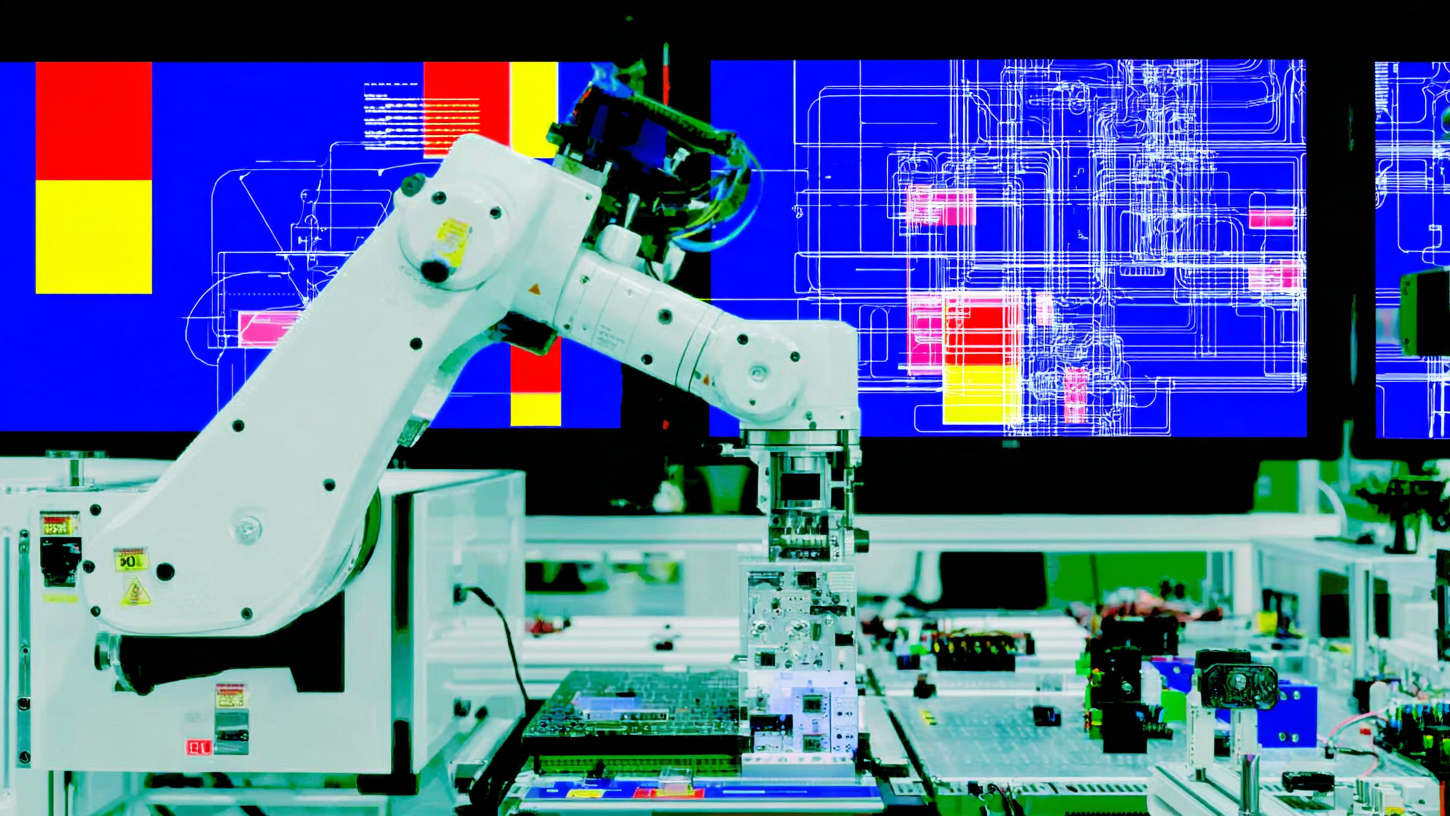
- Graph-as-Policy, or GaP, is a framework that lets agents generate, connect and test skills for robots to complete tasks. For instance, the system will segment skills such as finding an object, planning a grasp and moving the gripper without collisions into individual parts. The agent then connects these skills and uses Nvidia Isaac to simulate and rehearse them.
- VABAR, or Variational Automation Benchmark for Agentic Robotics, is an evaluation designed to measure a robot's capabilities at six types of industrial tasks under different conditions. This encompasses a range of tasks, including things like tool sorting and handing, syringe packing, and cable insertion and routing. Within this, a robot can simulate "contact-rich robot-object interactions" using Nvidia's simulation technology, which is then judged on Nvidia's Isaac Lab-Arena, the open-source policy evaluation framework.
Ken Goldberg, professor and distinguished chair in engineering at UC Berkeley, told The Deep View that the idea of agentic robotics is a fundamental shift from what many in robotics are doing, relying on a language model to write code for robots on the fly, rather than the current common paradigm of using data to improve vision-language-action models or world models. While this approach can complement those methods, it also provides its own alternative, he said.
This method could allow robots to actually scale in production by solving the challenge of reliability, as "data-driven" approaches, which require tons of real-world data, have hit a "plateau at 80% reliability," Goldberg said. "That's good enough for writing research papers and for people to declare that as state-of-the-art, but the industry is not happy with that, and it's not enough … for an industrial application."
Additionally, while this is scoped towards industrial use cases for now, Jim Fan, director of AI and distinguished research scientist at NVIDIA, told The Deep View that it's a "general-purpose paradigm." That means that it can eventually expand to robotic applications in retail and, eventually, home settings, serving as a step towards a major goal in the robotics industry: generalization.
"These days, the frontier models are actually really good at generalization," said Fan. "I think agentic robotics will really help us clean up the dirty laundry that none of us want to do."
Our Deeper View
Along with potentially representing a major step towards the long held industry challenge of general-purpose robotics, Nvidia and UC Berkeley's system also counters a common industry theme that visual AI models, such as world models and vision-language-action models, are the key to solving this challenge. These types of models are often hindered in their growth by the fact that authentic, real-world data tends to be more limited than language data, something that Goldberg has pointed out in previous research on the so-called "100,000 year data gap." However, there is an additional beneficiary to agentic robotics: frontier AI labs. If agents run by large language models are put in charge of designating token-dense actions for factory robots, that could create a massive new revenue stream for the frontier labs.
or get it straight to your inbox, for free!
Get our free, daily newsletter that makes you smarter about AI. Read by 750,000+ from Google, Meta, Microsoft, a16z and more.